Rev. Soc. Bras. Enferm. Ped.2023;23:eSOBEP20230040.
Difficulties and sensory motor changes in feeding in premature infants in the first years of life

DOI: 10.31508/1676-379320230040i
Abstract
Objective
To describe the eating difficulties and changes in sensory motor aspects of feeding in the first three years of corrected age of premature infants.
Methods
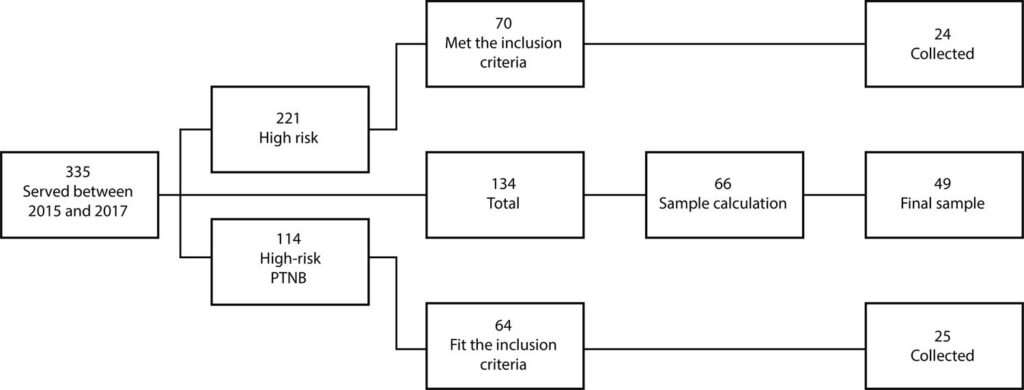
Cross-sectional study with 49 premature with corrected age (GA) between 24 and 36 months, born between 2015/2017. A specific assessment instrument was used, which includes about food, assessment of the stomatognathic system and feeding. To analyze the observed effect, the sample was divided into those born with GA <32 weeks and GA> 32 weeks. Data analyzed in the XLSTAT® software using the chi-square test for Independence and the Monte Carlo method if categorical counts <5, significance level of 5%.
Results
Despite not having statistical significance (p=0.138), the GI group >32 weeks, had a lower incidence of food discomfort compared to the group <32 weeks, which showed higher frequencies of changes in oromotor aspects of feeding in pasty and solid consistencies related to lip sealing in swallowing, suggestive signs of penetration/ laryngeal aspiration and chewing.
Conclusion
Both groups presented complaints of eating difficulties, identified by changes in sensorimotor aspects of feeding. However, it was evidenced in the group of those born with less than 32 weeks more complaints of discomfort during alimentation.